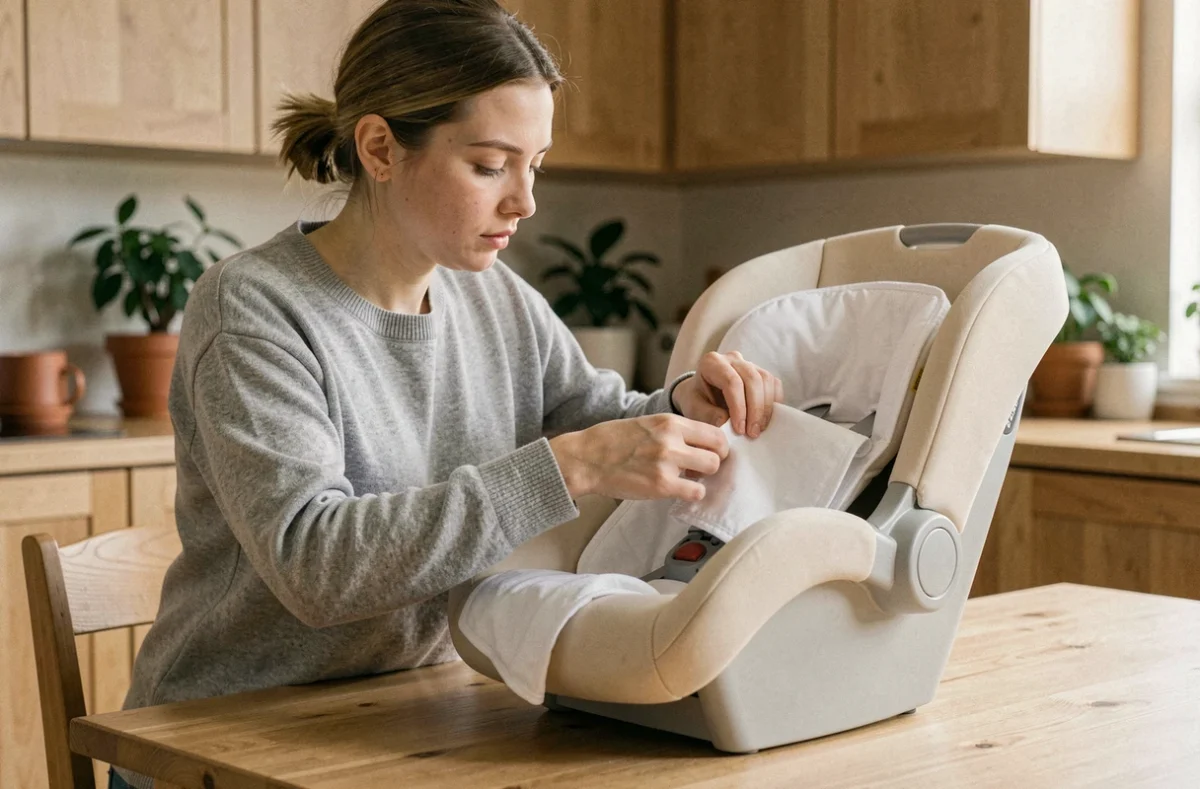
The cozy reducer is a removable cushion designed to fill the space between a newborn’s body and the car seat shell. Its main function is to prevent the head and torso from tilting sideways during trips, as long as the baby’s muscle tone is not sufficient to stabilize their posture. Removing it at the right time involves a balance between safety and comfort, which does not boil down to a specific age.
Harness alignment and shoulder position: the real criteria for removal
Most parents look for a reference age. Forums often mention three or four months. This chronological marker poses a problem: two babies of the same age can have very different sizes.
The reliable criterion is the position of the shoulders in relation to the harness slots. When the harness straps come from slots that are at or just below the child’s shoulders, the reducer is still doing its job. As soon as the shoulders exceed the highest slot of the body cushion, it compresses the torso and prevents the harness from fitting properly against the collarbones.
A poorly positioned harness loses a significant part of its retention capacity in the event of sudden braking. The reducer, which served as protection, then becomes a risk factor. To find practical information on CM 35, the logic remains the same: observe the morphology rather than the calendar.
The second indicator concerns the independent head support. As long as the baby’s head tilts forward or to the side as soon as they fall asleep, the lateral support of the reducer remains useful. When the baby can hold their head upright for several minutes in a row, including in a semi-reclined position, the body cushion no longer has a biomechanical justification.

Body cushion and head support: two elements to distinguish in the cozy
Since 2024, some manufacturers have separated their guidelines for the body cushion and head support (the piece that surrounds the skull). On several recent models, the head support remains mandatory throughout the use of the shell, even after the removal of the body cushion.
This evolution changes the approach to removal. Previously, the reducer formed a single block: it was removed entirely. Today, the manual may require removing the body cushion as soon as the shoulders reach the highest harness slot, while keeping the integrated headrest in place.
Why this distinction matters for car safety
The body cushion reduces the volume of the seat at the torso level. It ensures a snug fit of the harness around a small frame. Once the torso naturally fills the space of the shell, this cushion is no longer necessary.
The head support, on the other hand, protects against lateral impacts. An infant’s skull represents a significant proportion of their total weight. Without lateral support, a side impact can cause a sudden rotational movement. This is why some manuals produced after February 2024 require this piece to remain in place until transitioning to the next group seat.
Cozy reducer: check the manual before making any decision
The thresholds for removal vary from brand to brand. Some shells set a minimum weight (around five kilograms) below which the reducer must remain in place. Others combine a weight and shoulder position pair as a double criterion.
Consulting the manual for the exact model is the only reliable step. Here are the points to look for:
- The weight or height at which the body cushion can be removed, often indicated in a table or assembly diagram.
- The possible mention of a head support to be kept separately, with its own usage limit.
- Instructions for adjusting the harness after removing the reducer, as the height of the straps must be readjusted to compensate for the lost thickness.
If the manual is unavailable or too brief, the manufacturer’s website usually offers a downloadable PDF based on the model number.
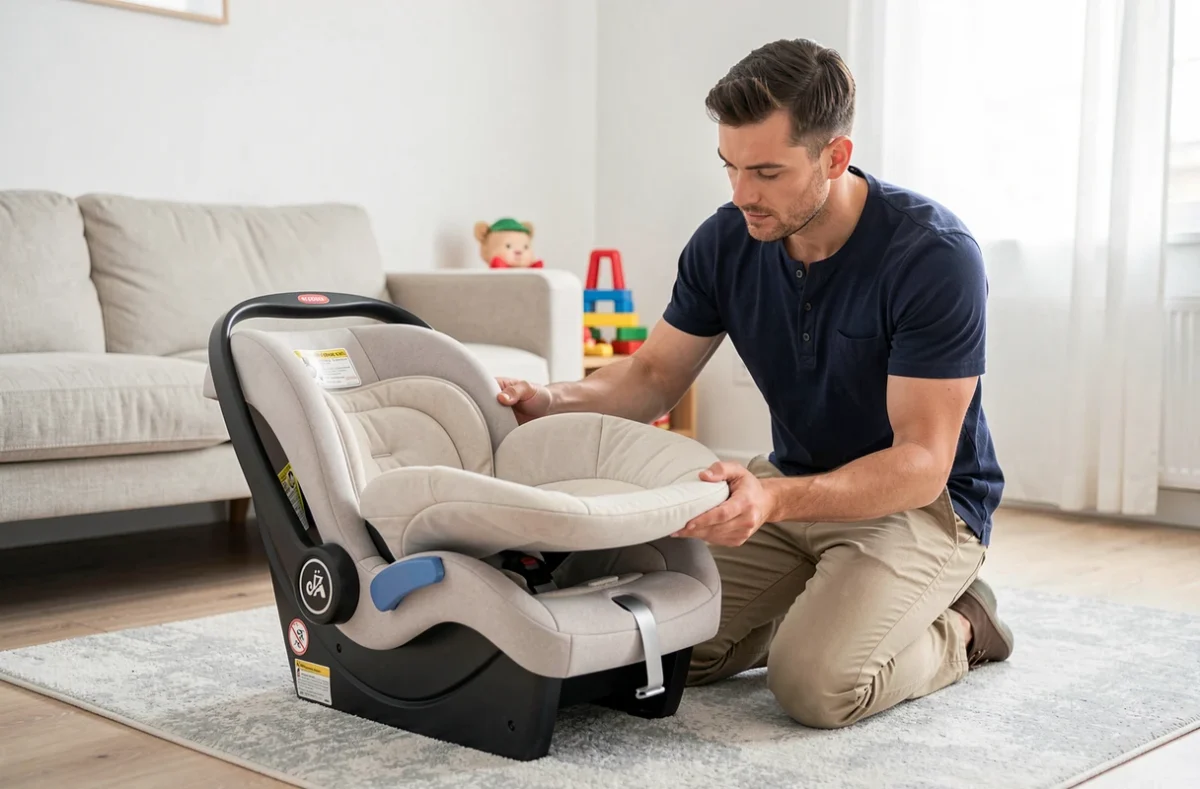
Concrete signs that the cozy reducer is bothering your baby
Beyond technical criteria, the child’s behavior in the car seat provides clear indications. Several typical situations deserve attention:
- The baby squirms or cries systematically as soon as they are placed in the cozy, whereas they were calm before. The shoulders seem compressed against the edges of the cushion.
- The harness, even at the loosest adjustment, leaves red marks on the skin at the thighs or torso. The volume of the reducer prevents smooth passage of the straps.
- The child sweats profusely on their back despite moderate temperatures. The extra foam thickness creates an excessive insulating layer for a baby whose thermoregulation is still immature.
A baby stuck in a reducer that is too small is less protected than a baby placed without a reducer in a shell suited to their size. The harness must be able to tighten properly over the shoulders, with a maximum finger’s width of play between the strap and the collarbone.
After removal: adjust the car seat
Removing the reducer changes the baby’s position in the shell. The head is slightly lower, and lateral space increases. Therefore, the harness straps need to be raised to the slot corresponding to the new shoulder height, and the abdominal buckle must be tightened.
If the baby’s head exceeds the upper edge of the shell after removing the reducer, the cozy itself has become too small. Transitioning to the next group car seat, still rear-facing as long as the seat’s standard allows, then becomes necessary.
Removing the reducer is not a one-time event scheduled on a calendar. It is a regular check, about every two weeks during the first months, observing the harness fit on the shoulders and the child’s behavior during trips.