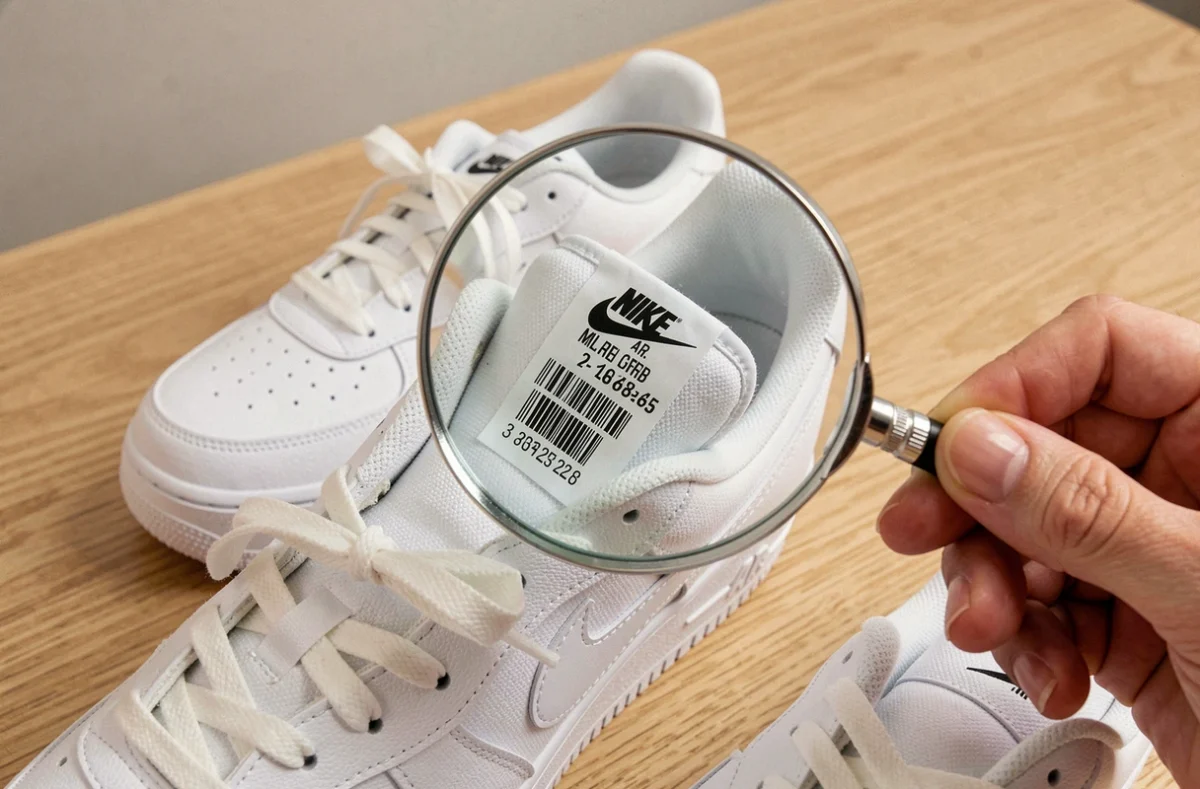
The market for reselling Nike sneakers is based on a paradox: the codes printed on the inner label of a pair (style code, UPC/EAN, date of manufacture) are often brandished as proof of authenticity, while Nike itself does not provide a public tool to verify a serial number online. Understanding what these codes indicate, and especially what they do not indicate, helps avoid the most common pitfalls.
Nike Style Code: What the xxxxxx-xxx Format Really Reveals
Each Nike model is identified by a nine-digit code in the xxxxxx-xxx format, known as the style code. This code appears on the label sewn inside the shoe, on the box, and on the purchase receipt. Nike officially uses it to process warranty claims, alongside the date of manufacture and the place of purchase.
The style code links a pair to a specific model: colorway, version, release year. On the Nike website, each product page displays this code. A first instinct is to look for the code on the label and verify that it matches the model claimed by the seller. If the code refers to a different colorway or a different model, the pair presents an obvious problem.
However, a valid style code does not prove that a pair is authentic. Counterfeiters copy these codes from Nike product pages, making simple format verification insufficient. As detailed in the article on Lydie Tendances, the serial number must be cross-referenced with other physical indicators to have real value.
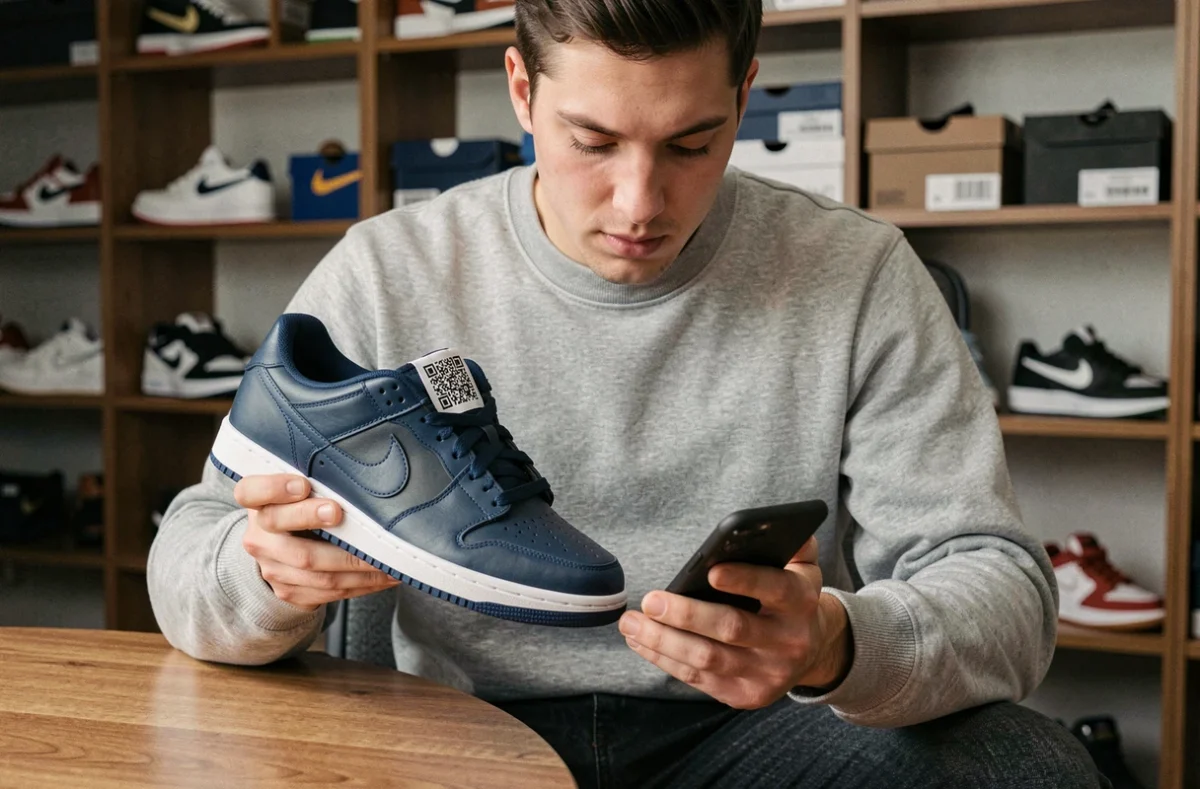
Checking the Nike UPC/EAN Code via the GEPIR Database
Below the style code, the label displays a barcode accompanied by a UPC (in the United States) or EAN (in Europe) number. This code identifies the product in global distribution systems. The GEPIR database, managed by GS1, allows you to verify which company a barcode prefix is assigned to.
The process is as follows: enter the UPC/EAN code into the GEPIR search engine and check that the result points to Nike, Inc. If the prefix refers to another company or is not recognized, the pair is suspicious.
Concrete Limitations of This Method
GEPIR only confirms that the prefix of the code belongs to Nike. The database does not verify whether this specific code has been assigned to a given model, nor whether the pair bearing it came from an authorized factory. A UPC code copied from an authentic pair will pass the GEPIR test without difficulty. This verification eliminates the most blatant counterfeits, those that use invented codes, but not the well-crafted copies.
Date of Manufacture and Consistency with the Model
The inner label also mentions the country of manufacture and a production date. Nike uses this date to define the coverage of its warranty: manufacturing defects are covered within two years of the date printed on the label, according to the conditions published by the brand.
This date provides a clue of consistency that is often overlooked. A model released in 2024 cannot display a manufacturing date of 2021. Similarly, if the date is later than the purchase date, something is amiss. Counterfeiters sometimes overlook this detail, providing an additional checkpoint.
- Check that the manufacturing date precedes the model’s release date and the purchase date.
- Compare the country of manufacture (Vietnam, China, Indonesia are the most common for Nike) with the information available on the product page.
- Observe the typography of the label: regular font, clean alignment, absence of errors. Counterfeit labels often show discrepancies in character size or irregular spacing.
NFC Chip on Nike Sneakers: A Still Marginal Protection
Some authentication guides mention the NFC chip as the ultimate proof. The reality is more nuanced. Nike has documented the presence of an NFC chip on the RTFKT x Nike Dunk Genesis collaboration, allowing the physical pair to be linked to a digital object. This technology is not deployed across the entire Nike catalog.
The absence of an NFC chip does not mean a pair is fake. Conversely, the presence of a chip on a model that normally does not have one should raise alarms. Field reports vary on this point: some recent pairs incorporate elements of digital traceability, while the majority of common models (Air Force 1, Air Max, Dunk Low) do not have them.
Seller’s Provenance: A Filter as Reliable as Inspection
Nike specifies that products purchased from unauthorized resellers are not eligible for its warranty inspection. This position underscores a point that code verification methods do not replace: the reliability of the purchasing channel. A study published by the British Intellectual Property Office, concerning counterfeit purchases, describes a trend towards using major platforms and social networks to sell copies.
Cross-referencing the serial number with the provenance remains the strongest combination. A consistent style code, a UPC verified via GEPIR, and a purchase made from an authorized Nike reseller form a much more robust set of indicators than any one of these elements taken in isolation.
- Prefer official Nike resellers or platforms with an integrated authentication service.
- Always request the original purchase receipt, which mentions the style code and sale price.
- Compare the inner label of the pair with high-resolution photos of the same model published on the Nike website.
No single method guarantees the authenticity of a pair of Nike sneakers. The serial number is a starting point, not a conclusion. The quality of the label, the consistency of the dates, GEPIR verification, and the seller’s traceability together form a credible check. The code alone is never enough; it is the cross-referencing that protects the buyer.